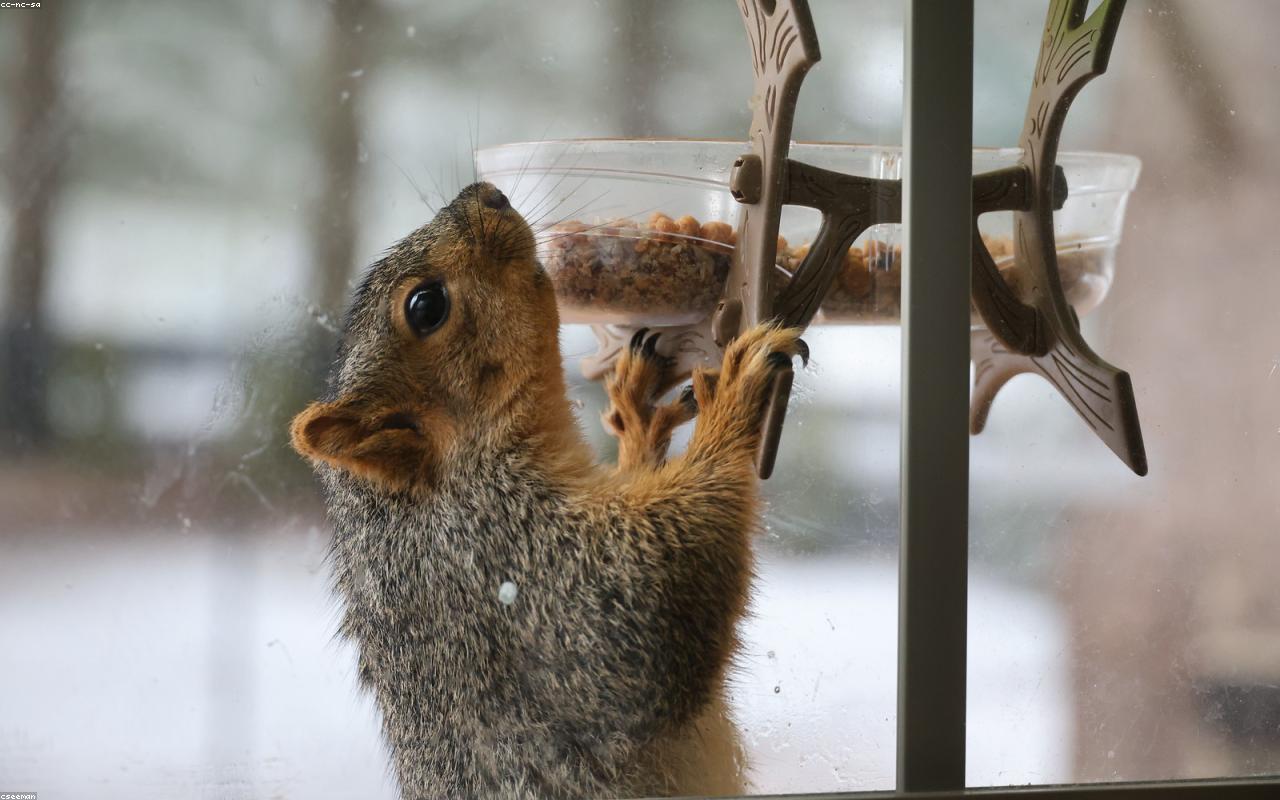
Brenda Olafsson of St. Cloud, Minnesota, has counted the birds at her kitchen-window feeder every other week from November through April for thirty-one years. She uses a yellow notebook from a stationary shop in town that closed in 2011. She has bought up the remaining stock, which she estimates will last her another nine years.
Project FeederWatch began in the winter of 1976 as a Canadian effort coordinated by Long Point Bird Observatory in Ontario. In 1987 it expanded continent-wide through a partnership with the Cornell Lab of Ornithology and Birds Canada. The protocol has remained essentially unchanged for forty years.
The method is simple. Participants designate a count area — typically a backyard or balcony with one or more feeders. They count birds during two consecutive days, then skip at least five days before the next count. They record the maximum number of each species seen at any one time during the count period. They do this from late November through early April.
The data they produce are, technically, an index of feeder use rather than of bird abundance. A bird that visits a feeder is counted. A bird that does not is not. This is a real limitation, and the analysis literature treats it as such.
What FeederWatch is good at is documenting which species use feeders, where, and how this changes over time. That has turned out to be more interesting than it sounds.
The most cited paper to emerge from the dataset, published in 2019 by a team led by Emma Greig at Cornell, mapped the gradual range expansion of the Eurasian collared dove across North America. The species was first reported on FeederWatch counts in Florida in 1986. By 2000 it was on counts in eighteen states. By 2018 it was on counts in forty-eight states and most Canadian provinces.
The FeederWatch data, which include precise locations and counts going back forty years, allowed the researchers to date the species' arrival in each county across the continent, producing one of the most detailed maps ever made of an avian invasion. The map shows the dove moving northwest from Florida at roughly eighty kilometres per year — a pace that no professional survey would have been positioned to document.
Another finding, less dramatic, has accumulated quietly. The dataset shows that the proportion of FeederWatch sites reporting evening grosbeak has declined from approximately fifty percent in 1989 to under five percent in 2024. The species, once a winter staple across the northern US and Canada, has effectively disappeared from suburban feeders.
The cause is not fully understood. Spruce budworm cycles, on which the grosbeak depends in summer, have shifted. Forest composition has changed. Disease may have played a role. The FeederWatch data document the disappearance without explaining it, which is the limitation and the strength of the project.
Brenda Olafsson saw her last evening grosbeak at her feeder in February 2011. She remembers because it was the morning her grandson was born and she was waiting for the phone to ring.
FeederWatch has documented other shifts. Red-bellied woodpecker, historically a southeastern species, now appears at feeders well into Minnesota and southern Manitoba. Carolina wren has expanded north similarly. Both range shifts are consistent with the climate-driven northward expansion documented in other datasets, but FeederWatch is unusually well-positioned to detect them at fine spatial resolution because backyard observers are densely distributed across the continent.
The dataset has also been useful in documenting disease outbreaks. The mycoplasmal conjunctivitis epidemic that swept through North American house finch populations beginning in 1994 was first noticed by FeederWatch participants who reported birds with crusty, swollen eyes at their feeders. Within a few years, researchers were using FeederWatch reports of symptomatic birds to track the epidemic's spread across the continent in near-real-time.
The current participation in FeederWatch is approximately twenty thousand active participants per season. The annual cost of running the project is in the range of three hundred thousand dollars, split between Cornell and Birds Canada. Participants pay a small annual fee — currently eighteen dollars in the US, fifteen dollars in Canada — that covers most of the operating budget.
The participation fee has been controversial in citizen-science circles. eBird is free. The Breeding Bird Survey is free. FeederWatch charges. The Cornell Lab's position has been that the fee funds the data management infrastructure and that participants value the project more for paying for it. The empirical evidence on this is mixed.
The fee structure also limits participation by lower-income observers. The lab has scholarship programs for school groups and community organizations, but the program's demographic skews older and more affluent than the general population, even more so than eBird does.
What FeederWatch produces, despite these limitations, is a uniquely long and consistent record of which species visit which feeders across a continent. The dataset is now over forty years deep. Its temporal coverage is unmatched.
The 2023 dataset includes records from feeders in every US state, every Canadian province and territory, and a small number of locations in Mexico and the Caribbean. The participants range from second-graders counting at a classroom window to retired carpenters at rural farmsteads to apartment-dwellers on twelfth-floor balconies in Toronto.
Brenda Olafsson's records are part of this. Her kitchen window. Her yellow notebook. Her count of, in the winter of 2025 to 2026, twenty-three species across twenty-one count days, including her usual winter cohort — black-capped chickadee, blue jay, downy woodpecker, hairy woodpecker, white-breasted nuthatch, red-breasted nuthatch — and one unusual visitor, a Townsend's solitaire that arrived during the cold snap in mid-January and stayed three weeks.
She submitted the solitaire record online. She got an email from the project coordinator asking her to confirm. She did. She is, after thirty-one years, used to the process.
The Townsend's solitaire record is now in the dataset. Someone, somewhere, in a decade or two, will map the species' winter range expansion using points like hers. They will not know her name. The map will, in a sense, be a portrait of her kitchen window and twenty thousand others.