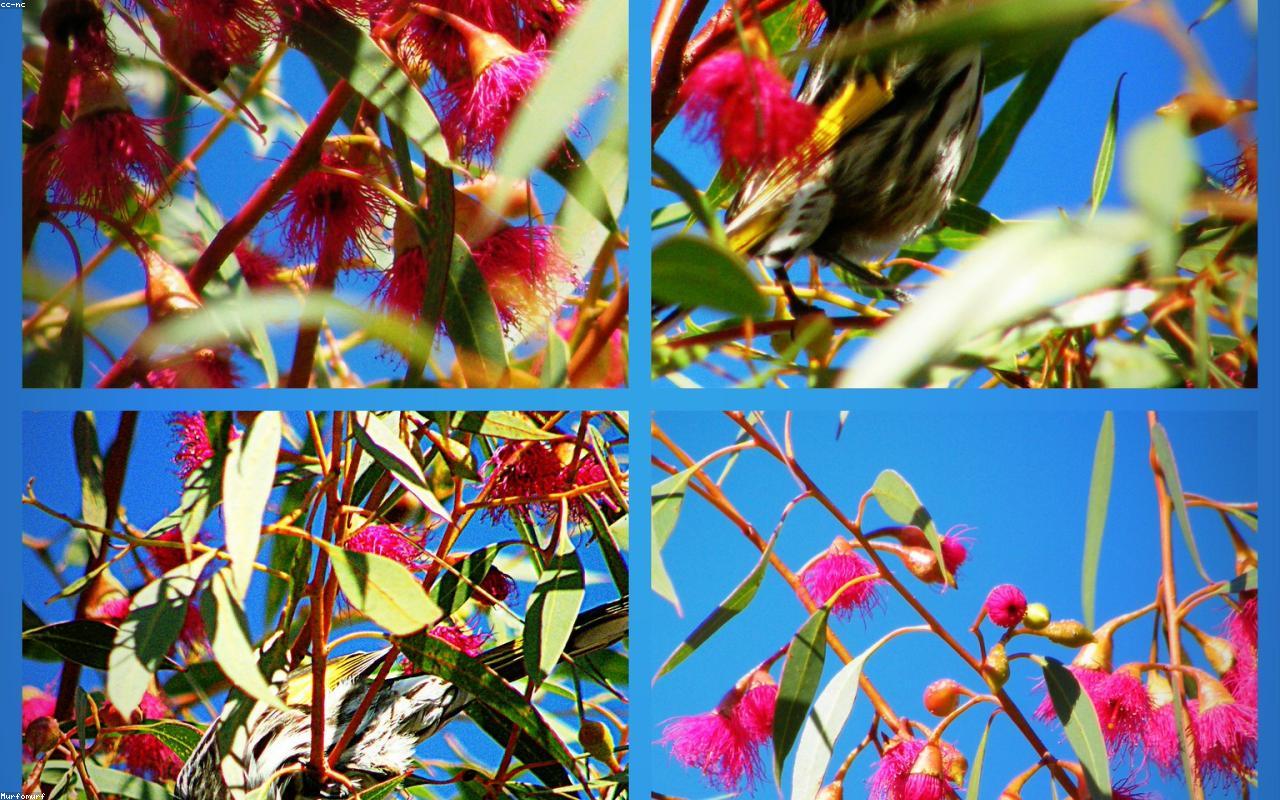
In a stand of grey box eucalypts near Chiltern, Victoria, on a clear morning in May, the male regent honeyeater designated AC-114 was singing the song of a little wattlebird.
Dr. Naomi Hsu of the Australian National University recorded eight minutes of it on a parabolic microphone from a position roughly fifteen metres from the bird. The recording is now part of the project's archive of song-loss documentation, which began in 2018 and has grown to more than 1,200 vocalisations across forty-six individuals.
Regent honeyeaters, Anthochaera phrygia, are critically endangered. The Australian government's most recent population estimate is between 250 and 400 wild adults. The species was, as recently as the 1950s, abundant across the eucalypt woodlands of south-eastern Australia.
What is happening to the regent honeyeater's song is unusual. The bird is not losing the physical capacity to vocalise. It is losing the cultural template.
Songbirds learn their species-typical song from older conspecifics during a defined developmental window. When the older birds are absent or too few to teach, the young improvise from whatever vocal models are available. In the regent honeyeater's case, the available models have become other species entirely.
Hsu's published work, in collaboration with Ross Crates and Dejan Stojanovic, documents male regent honeyeaters singing recognisable phrases borrowed from at least seven other species, including little wattlebird, friarbird, eastern rosella, and pied currawong.
Some males sing no recognisable regent honeyeater phrases at all.
The consequence is reproductive. Female regent honeyeaters appear to require species-typical song as a mate-recognition cue. Males who cannot produce it have lower pair-bonding success. The population's reproductive output is reduced, in part, by its own forgetting.
The cause is straightforward in outline and difficult in detail. The regent honeyeater's preferred habitat, box-ironbark woodland with mature flowering eucalypts, has been reduced by approximately 75 percent since European settlement. Remaining habitat is fragmented across a thousand-kilometre east-west span from southern Queensland to central Victoria.
Fragmentation reduces encounter rates between juveniles and adults. Encounter rates determine whether learning happens. The arithmetic is not subtle.
Captive breeding, run from Taronga Zoo's western Sydney facility, has released more than 250 birds since 2008. The releases have had partial success. The released birds learn from the captive song training, which uses recordings of historically wild regent honeyeaters, but the survival rate of released birds in their first year averages below 30 percent.
Hsu spent five days at Chiltern in May. She located eleven birds, of which seven were males in territorial song. Of those seven, two produced phrases she classified as conspecific-typical. Three produced phrases she classified as mixed. Two produced phrases entirely borrowed from other species.
The mixed singers are, in some respects, the most interesting case. They retain some species-typical material and have added or substituted other material on top of it. Whether their offspring, if they have offspring, will inherit the mixed repertoire or revert to the typical pattern is not yet known.
Mark-resight data suggests that AC-114, the bird singing the little wattlebird song, has held a territory near Chiltern for three breeding seasons without successful pair-bonding.
The recovery community has begun, in the last four years, to use the term cultural extinction. The phrase is contested. Some biologists prefer cultural erosion. Others reject the framework entirely as imposing a metaphor where the underlying biology is sufficient on its own terms.
Hsu uses the term sparingly. She uses behavioural terms when she can.
What is undisputed is that the recorded historical song of the regent honeyeater, captured on tape and disc between the 1970s and the early 2000s, now constitutes a more complete reference of the species' vocal repertoire than the living wild birds themselves can produce.
The Taronga captive flock is taught from these recordings. Whether the captive-taught song survives transmission through one or two wild generations is the central empirical question of the next decade of recovery work.
Hsu was back at Chiltern in late May to record AC-114 again. He was still singing the wattlebird song. He had added, in the intervening fortnight, what sounded to her trained ear like a fragment of a friarbird's grating call, possibly from a neighbouring bird the previous month.
The recording is in the archive. The bird is still unpaired. The forest around him is, by every measure that matters to a regent honeyeater, too quiet.