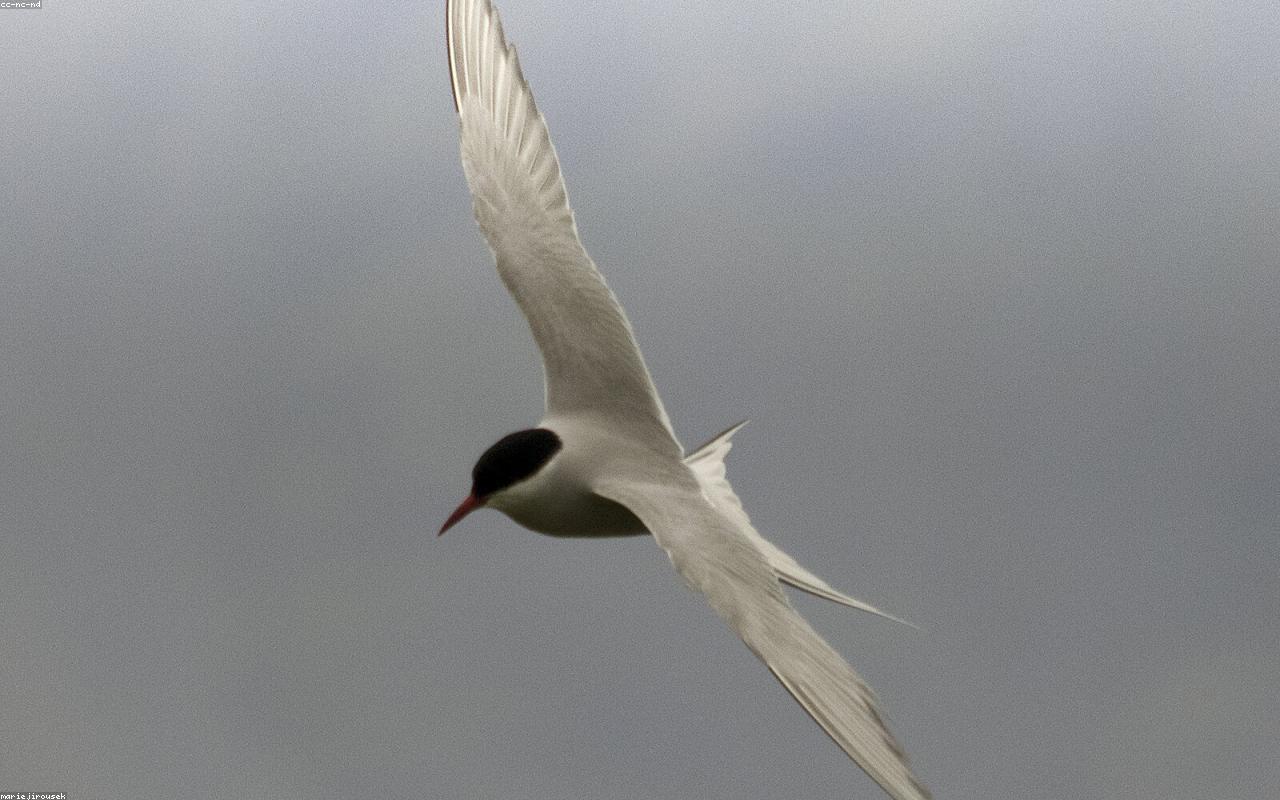
In June of 2010, a researcher named Carsten Egevang clipped a 1.4-gram geolocator to the leg of an Arctic tern on a small cliff in the Farne Islands, off the Northumberland coast. The device weighed less than a paperclip. The bird itself weighed about 110 grams. He noted the band number in pencil, set the bird down, and watched it lift off toward open water.
Twelve months later, the bird returned to within forty metres of the same cliff. Egevang recovered the geolocator. The data, decoded over the following weeks at the Greenland Institute of Natural Resources, showed the bird had flown roughly 70,900 kilometres in a single year.
This was not entirely a surprise. Ornithologists had long suspected that Sterna paradisaea made the longest annual migration of any animal on Earth. What the geolocators added, beginning with the Egevang study and continuing through more than a decade of follow-on work, was specificity. The route was not a straight line. It was not even close.
The terns that breed on the Farnes do not fly directly south to their Antarctic wintering grounds. They drift in long S-curves down the eastern Atlantic, pause for weeks at productive upwelling zones off West Africa, cross to Brazilian waters, and only then continue south toward the pack ice of the Weddell Sea. The route is shaped almost entirely by wind and food, not geography.
By the time a Farnes tern reaches its austral summer feeding grounds in late November, it has been on the wing or on the water for nearly three months. It will spend roughly 110 days there. Then it will turn around and do the whole thing in reverse, taking a different route, almost always farther west.
Richard Phillips, a seabird ecologist at the British Antarctic Survey, has tracked terns from several breeding colonies. He notes that the variation between individuals is striking. Two birds nesting on the same boulder in June may take routes that diverge by 4,000 kilometres in November.
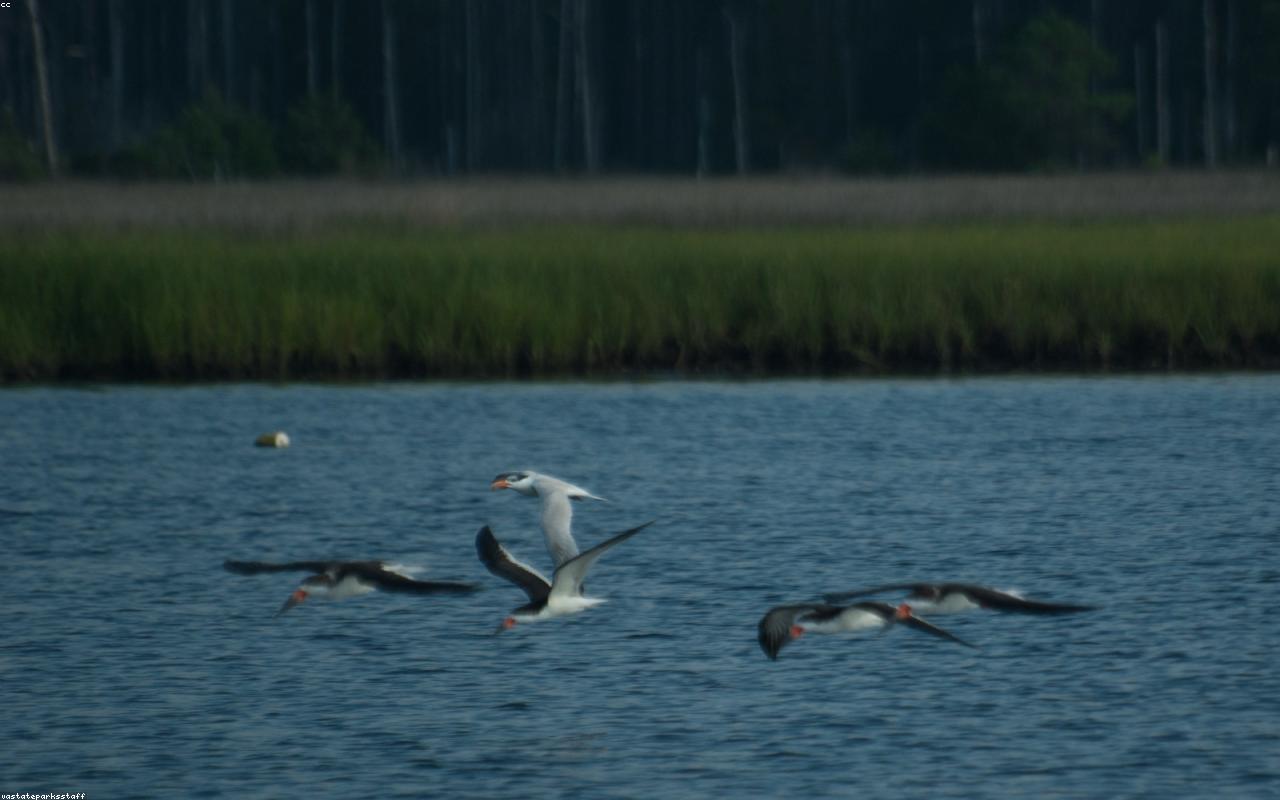
The energetic cost of all this is not as ruinous as it sounds. Arctic terns are extraordinary flyers, with long, narrow wings adapted for sustained soaring at low altitude over water. They feed on the wing, plucking small fish from the surface in shallow plunge-dives. They do not, so far as anyone has observed, ever land on the open sea.
Most of the year, then, an Arctic tern is either flying or standing on ice. It is one of the few vertebrates that experiences two summers per calendar year and almost no true night, since its route is bounded at both ends by the long days of high latitudes.
The implications for life expectancy are odd. Banded Arctic terns have been recovered alive in their thirties. A bird ringed as a chick on the Inner Farnes in 1980 was found, still breeding, on the same island in 2015. Over a lifetime of thirty years, such a bird may fly more than two million kilometres, which is roughly the distance from the Earth to the moon and back, three times.
Egevang's original 2010 study, published in the Proceedings of the National Academy of Sciences in 2010, has been cited more than a thousand times. It established a methodology that has since been applied to dozens of seabird species. But it also did something quieter: it confirmed something that older field ornithologists had long believed without proof.
Among them was William Henry Hudson, who wrote in 1895 that the Arctic tern "sees more sunshine in a year than any other living thing." He had no geolocators. He had no banding data of any consequence. He simply watched the birds in Patagonia in January, knew they nested in Iceland in June, and did the arithmetic with what he had.
Modern tracking work has refined the estimate. The current consensus, drawn from data on several hundred individuals across colonies in Greenland, Iceland, the Netherlands, and Britain, is that the average Arctic tern flies between 70,000 and 81,000 kilometres in a typical migratory year, with substantial variation depending on breeding latitude and prevailing winds.
The longest single track on record belongs to a bird from a colony on the Dutch Frisian Islands, monitored in the 2014-2015 season. It logged 90,108 kilometres in fourteen months. It returned to its nest in spring as if nothing had happened.
Whether this kind of behaviour can persist is now an open question. The terns' migration depends on a chain of marine productivity that runs the length of the Atlantic, from the Barents Sea to the Weddell. Each link in that chain is shifting under the pressure of warming surface temperatures.
A study published in Marine Ecology Progress Series in late 2025 documented a southward shift of roughly 320 kilometres in the principal West African foraging stopover used by Greenlandic terns. Birds were arriving at expected coordinates and finding the fish they had relied on no longer in concentration.
Some of the tracked individuals adjusted. They flew farther, fed less, and reached breeding grounds in poorer condition. Their hatching success was measurably lower the following summer. Other birds did not adjust. Their geolocators continued to broadcast position but stopped registering the dive behaviour associated with feeding.
Edith Crale, who has visited the Farnes annually since 2009, says the colonies look much as they did when she first saw them. The cliffs are still loud. The birds still wheel against grey water. The visual impression is one of abundance.
But the published numbers from the Farne Islands Special Protection Area show a fifteen percent decline in breeding pairs between 2018 and 2024. A single bad season in 2022, when avian influenza tore through the colony, accounted for much of it. The recovery has been slow.
What the geolocators tell us, in the end, is that a Farne Islands tern is not really a British bird, or a Greenlandic bird, or an Antarctic bird. It is a creature of the whole hemisphere, and its survival depends on what happens in places its observers will never visit.
Carsten Egevang still works in Greenland. He is, by his own description, more cautious now than he was in 2010. The data has accumulated. The terns have flown the routes the data describes, and they have done so faithfully for as long as anyone has watched. What they will do as the routes themselves change is the harder question, and the one nobody yet has an answer to.