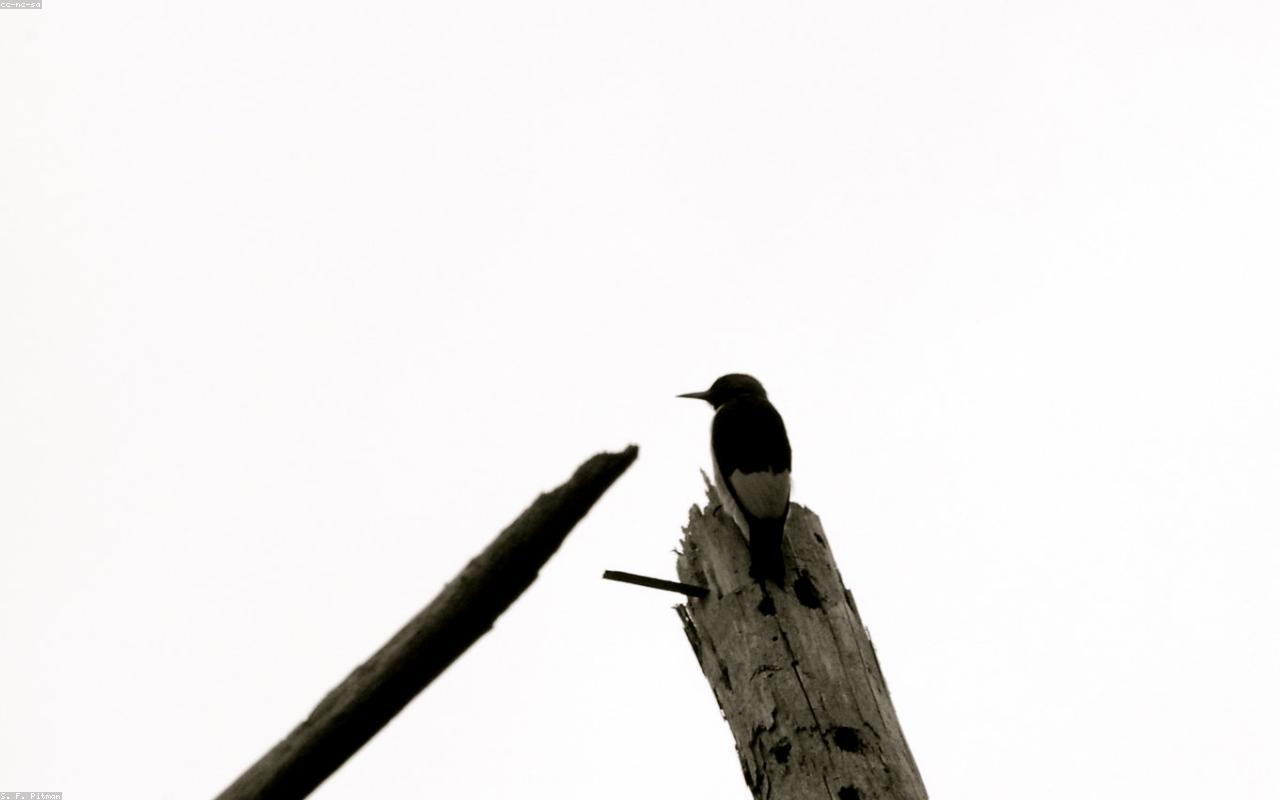
In a stand of young jack pine in Crawford County, Michigan, on May 28, a male Kirtland's warbler sang from the same square metre of branch he had sung from the previous afternoon. The pine was eleven years old. In four more years, the bird would not return.
Kirtland's warbler (Setophaga kirtlandii) is the most habitat-specialized songbird in North America. It breeds almost exclusively in young jack pine forests of a narrow age class, between roughly six and twenty years post-fire, with trees in the four-to-six-metre range. Older than that, the lower branches die back and the bird abandons the stand. Younger than that, the trees do not yet provide nesting cover.
The habitat exists, at any given moment, in a small fraction of the Lower Peninsula of Michigan, plus expanding outposts in Wisconsin and Ontario. The bird winters in the Bahamas, almost exclusively in a similarly narrow band of broadleaf scrub.
It is one of the great near-misses of American conservation. In 1971, the singing male census across the entire breeding range counted 201 birds. By 1987 the number had dropped to 167. The species was, by any reasonable assessment, going to vanish.
It did not.
The recovery is the result of two things: aggressive cowbird control and active jack pine management. Both required commitments that no one expected to last more than a decade and which have, in the event, lasted more than four.
Brown-headed cowbirds (Molothrus ater) are obligate brood parasites. They lay their eggs in the nests of other songbirds, which then raise the cowbird chick at the expense of their own. Historically, cowbirds were associated with bison-grazed prairie. The expansion of agriculture and fragmentation of eastern forests pushed cowbirds into ranges where the host species had no co-evolved defenses. Kirtland's warbler, in particular, was being parasitized at rates approaching seventy percent of all nests by the late 1960s.
Beginning in 1972, the US Fish and Wildlife Service began trapping and removing cowbirds across the Kirtland's breeding range. The operation is unsentimental. Several thousand cowbirds are killed each year. The Kirtland's nest parasitism rate dropped to under five percent within a decade and has remained low since.
The jack pine management is more conspicuous. Jack pine is a fire-dependent species. Its serotinous cones open and disperse seed in response to heat. Without fire, mature jack pine stands eventually convert to other forest types. The bird's preferred age class — those six-to-twenty-year-old stands — historically existed because lightning-set fires regularly converted older stands to ash.
Modern fire suppression broke that cycle. The recovery effort restored it artificially. The Michigan Department of Natural Resources, in cooperation with the US Forest Service and US Fish and Wildlife Service, now clearcuts and replants roughly 3,000 acres of jack pine annually on a 50-year rotation. The plantings are dense, irregularly spaced, and designed to mimic post-fire regeneration.
Sarah Vandeven, a biologist with the Michigan DNR who has been working on the recovery since 2014, walked Roost through a 2019-planted block on the Au Sable State Forest in late May. The block was just entering the lower edge of suitable Kirtland's habitat. Three singing males had been counted in May 2026.
Kirtland's warbler will be the only songbird in this stand for the next decade, Vandeven said, and then it will leave. Other species will move in. We will burn the stand again or cut it. The bird will come back when we have new young pine somewhere else.
The 2026 range-wide singing male census, conducted in early June, counted 2,254 birds. The species was federally delisted in October 2019. The recovery is, by Endangered Species Act standards, complete.
But the delisting did not end the management. It cannot. Without ongoing cowbird control and active forestry, the bird's habitat closes and the bird disappears. The recovery is a permanent commitment masquerading as a finished project.
There is a deeper question, raised most pointedly by Jared Wolfe at Michigan Technological University in a 2022 paper, about what kind of species the Kirtland's warbler now is. Is it a wild bird, in the sense Helen Macdonald has used the term, or is it a domesticated species in a wild costume? The bird breeds in plantations that human crews planted, eats insects in habitats human crews maintain, and survives because human crews kill its competitors.
Wolfe does not advocate for ending the program. He observes, simply, that the categories we use to describe species — wild, managed, captive — do not fit Kirtland's warbler cleanly anymore.
On the morning of May 28, the male in the eleven-year-old pine sang at intervals of roughly 7 to 9 seconds between songs, from 5:51 a.m. until 7:14 a.m., when his rate slowed. He was almost certainly attending a nest already underway. The female, smaller and browner, was not visible during the observation period.
The pine was sticky with sap. The understory was almost bare. Blueberry plants were beginning to flower. The light was clean and the air was cold enough at first light to fog the binoculars.
The bird sang in the same square metre because the geometry of the branch suited him. In four more years, when the pine has grown another two metres and the lower branches have died back, the bird will be somewhere else, in a younger stand, planted by a crew that has not yet begun its work.